A paper co-authored by Dr. Seiichiro Ishihara of Hokkaido University’s Faculty of Advanced Life Science has been published in Cell Structure and Function.
- Toko Yamazaki, Yuji Kumagai, Kosuke Maeda, Tomoyasu Aizawa, Kosuke Maekawa, Atsushi Enomoto, Seiichiro Ishihara, Hisashi Haga. CCL5 enhances invasion of squamous cell carcinoma via syndecan-1-dependent ERK signaling. Cell Structure and Function 2026 Volume 51 Issue 1 Pages 227-235.
DOI: https://doi.org/10.1247/csf.26030
Abstrract
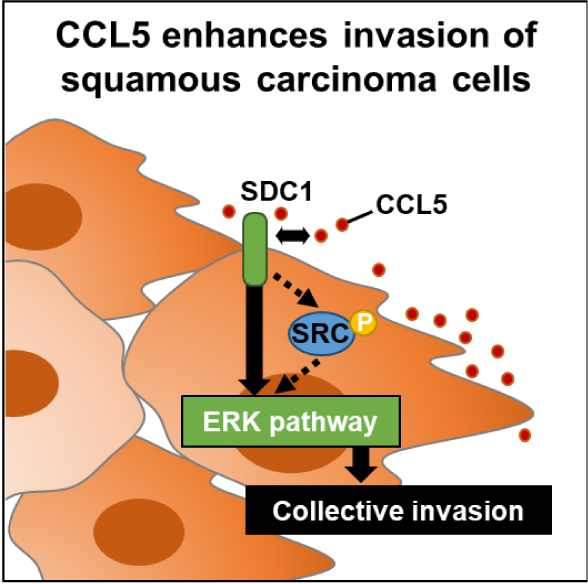
Cancer cells form clusters and invade the surrounding stroma. This phenomenon is associated with metastasis and poor prognosis in patients with cancer. Therefore, prevention of invasion may improve cancer therapy. A previous study suggested that the C-C motif chemokine ligand 5 (CCL5) is more highly expressed in the highly invasive subclone than in the less invasive subclone derived from A431 cell line, a model of human skin squamous cell carcinoma. However, the role of CCL5 and the mechanisms through which it regulates invasion in A431 cell clusters remain unclear. Herein, we investigated the molecular mechanisms underlying CCL5-induced invasion in A431 cell clusters. Knockdown of CCL5 suppressed invasion on A431 cell clusters, whereas treatment with recombinant CCL5 promoted invasion of them. Mechanistically, CCL5 increased the phosphorylation levels of Src and ERK, leading to the invasion of A431 cell clusters. Furthermore, the knockdown of syndecan-1 (SDC1), a transmembrane protein known to interact to CCL5, suppressed CCL5-induced invasion in A431 cell clusters. Consistently, knockdown of SDC1 reduced the level of phosphorylated ERK. These findings demonstrate that the CCL5 promotes the invasion of A431 cells clusters through SDC1-dependent ERK signaling and Src phosphorylation.
Key words: invasion, CCL5, syndecan-1, ERK signaling, Src