
A paper co-authored by Professor Mikako Ogawa of Hokkaido University’s Faculty of Pharmaceutical Sciences has been published in Organic & Biomolecular Chemistry .
- Haruka Tsuchiya, Osuke Yoshikawa, Mei Harada, Mikako Ogawa, Yuhei Ohta, Hidehiko Nakagawa, Naoya Ieda. Substituent effects on photoresponsive nitric oxide release by N-nitrosoaniline derivatives. Organic & Biomolecular Chemistry, (2026) 24 (23): 4865–4874
DOI: https://doi.org/10.1039/d6ob00679e
Abstract
Nitric oxide (NO) is a short-lived signaling molecule mediating physiological functions such as vasorelaxation, and photocontrollable NO releasers that enable precise spatiotemporal control of NO release are useful tools for studying NO bioactivity as well as potential therapeutic agents for cardiovascular diseases. We recently developed NORD-2 as a photoinduced electron transfer (PeT)-triggered NO+ releaser that responds to red light (λ 660 nm) by releasing NO in the presence of physiological concentrations of ascorbic acid or NO+ in the absence of ascorbic acid. Here, we aimed to explore the structure–activity relationship by investigating the photoreactivity of derivatives having various substituents in the NO-releasing moiety. Replacement of NORD-2’s methoxy group with all substituents examined reduced both NO+ and NO release. In particular, the introduction of a dimethylamino group completely suppressed the photoreaction. Quantum chemical calculations revealed that the differences in photoreactivity originate from differences in the propensity for transition to the charge transfer (CT) excited state. Furthermore, when the energy of the CT excited state is low, deactivation to the ground state is likely to occur, which may prevent N–N bond cleavage. Our results identify suitable structures to promote efficient bond cleavage following PeT, which should be helpful for developing various photofunctional molecules.
Visual Abstract
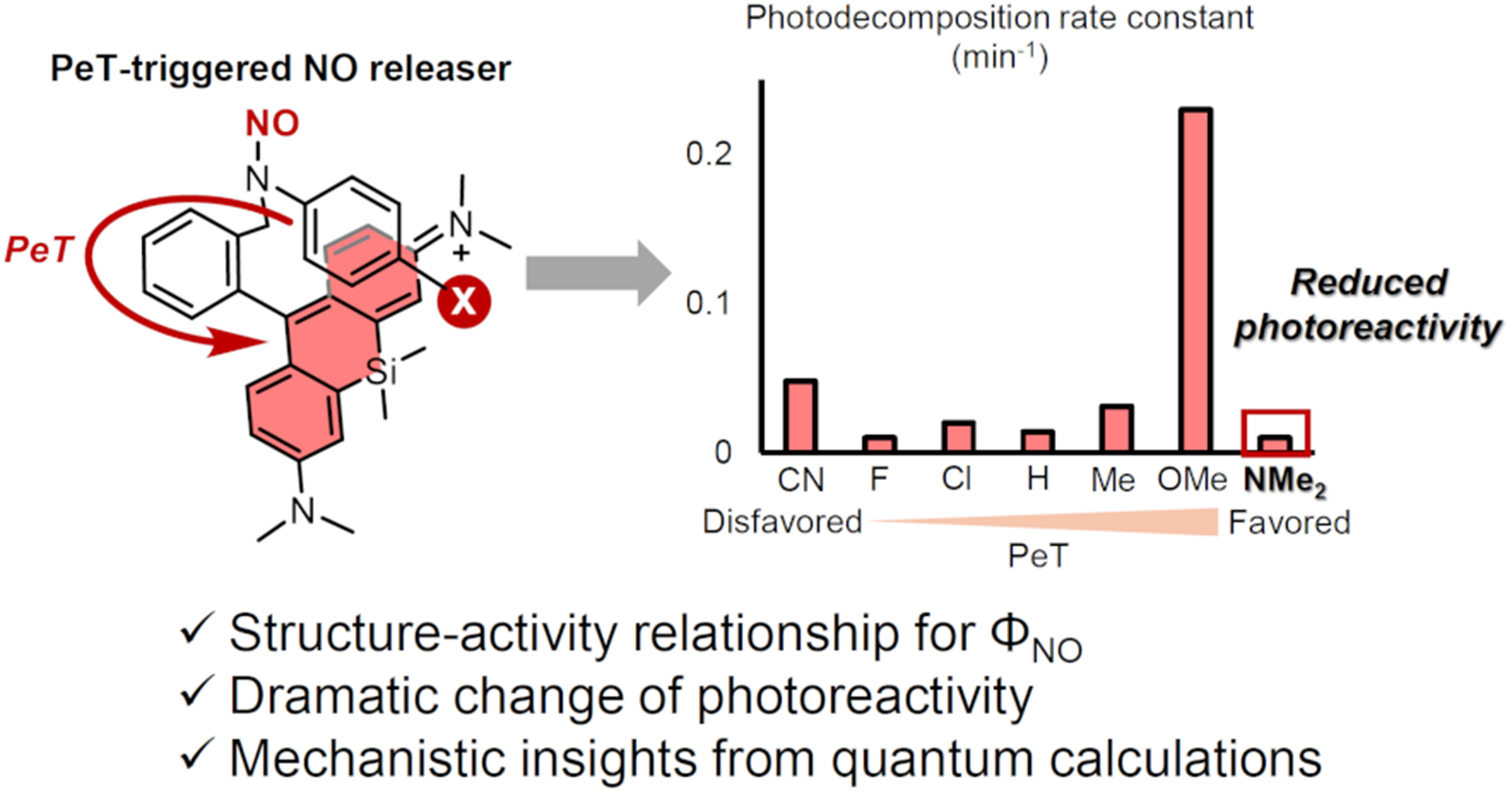
Credit: Tsuchiya et al., Organic & Biomolecular Chemistry, 24, 4865–4874 (2026), https://doi.org/10.1039/D6OB00679E. Licensed under CC BY 4.0.