
A paper by Professor Tetsuya Taketsugu of Hokkaido University’s Faculty of Science has been published in Physical Chemistry Chemical Physics.
- Hiroto Komuro, Kenichiro Saita, Takuro Tsutsumi, Tetsuya Taketsugu. Crystal-environment control of excited-state reaction branching in 5-chloro-N-salicylideneaniline. Physical Chemistry Chemical Physics, 2026; 28 (31): 18852–18861
DOI: https://doi.org/10.1039/d6cp01610c
Abstract
We investigated how crystal packing controls the photochromic reactivity of 5-chloro-N-salicylideneaniline (5CSA) by combining excited-state reaction-path analysis with ab initio molecular dynamics simulations for the isolated molecule and cluster models of its α- and β-phases. For the isolated molecule, the static pathway analysis revealed two competing relaxation channels near the S1 Franck–Condon region: an ESIPT pathway leading toward trans-keto formation through subsequent C–C twisting, and a competing C–N twist pathway leading toward twist-enol relaxation. The nonplanar α-phase showed branching behavior similar to that of the isolated molecule, whereas the planar β-phase exhibited a strongly biased branching toward ESIPT, indicating dynamic suppression of the competing C–N twist channel. Moreover, although ESIPT occurred efficiently in all environments, the subsequent C–C twisting required for trans-keto formation was strongly hindered in the β-phase. These results show that the phase dependence of photochromism is governed not by the occurrence of ESIPT itself, but by crystal-environment control over excited-state branching and post-ESIPT structural relaxation. The salicylideneaniline planarity rule is therefore understood not merely as a static structure–reactivity relationship, but as a dynamical consequence of crystal-environment-induced restriction of the reaction pathways leading to photoproduct formation.
Visual Abstract
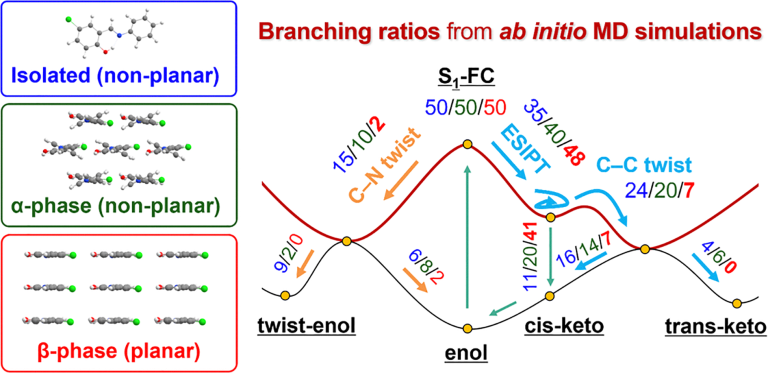
Credit: Minegishi, Y., Saita, K., Tsutsumi, T., and Taketsugu, T. (2025). “Unraveling the structural origins of stimulated emission redshift in cyanine dye 1122C: a combined AIMD and machine learning study.” Physical Chemistry Chemical Physics, 27, 19868–19876. https://doi.org/10.1039/D5CP02457A. Licensed under Creative Commons Attribution 3.0 (CC BY 3.0).