Research and Innovation for Sustainable and Resilient Food Production
What is Regenerative Agricultural, Forestry and Fisheries Research?
We conduct research on regenerative approaches in agriculture, forestry, and fisheries to restore natural systems and foster the next generation of researchers and practitioners.
Our research aims to revitalize soil and marine ecosystems, support biodiversity, and conserve forests and water.
We also work with farmers and fishers to improve their productivity and profitability.
This work contributes to building systems that ensure a safe and stable supply of food and other essential resources for society.
By translating our research into practice, we aim to advance sustainable well-being—where everyone can thrive.
Goals of Regenerative Agricultural, Forestry and Fisheries Research
- Provide nutritious food for the growing world population
- Regenerate and restore the ecological environment of forests, arable lands, and aquatic zones
- Reduce greenhouse gas emissions by fixing carbon and nitrogen in forests, soils, and oceans
- Restore biodiversity and marine biological resources
- Prevent deforestation by increasing the productivity of farmland and converting it to agricultural land
- Build a disaster-resistant fishery industry that balances the restoration of the coastal environment and the utilization of fishery resources
- Increase productivity and profitability of farmers and fishermen
What's New
-
 November 11, 2026
- EVENTS
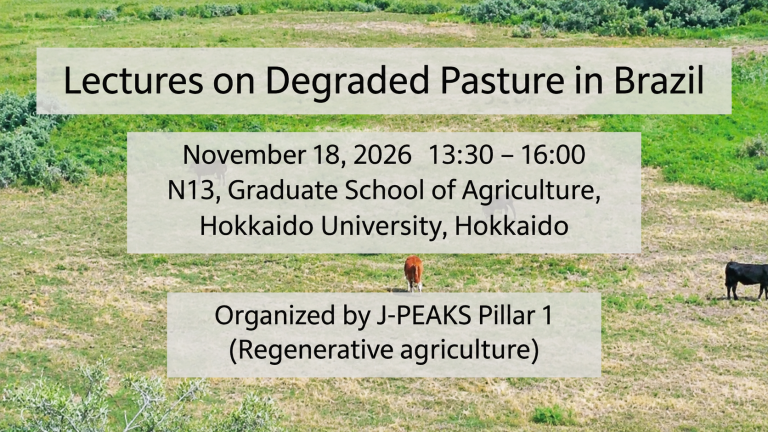
[Upcoming Seminar] Lectures on Degraded Pasture in Brazil (November 18) -
 November 10, 2026
- PUBLICATIONS
Paper co-authored by Professor Takagi has been published in Soil Biology and Biochemistry -
 November 7, 2026
- NEWS
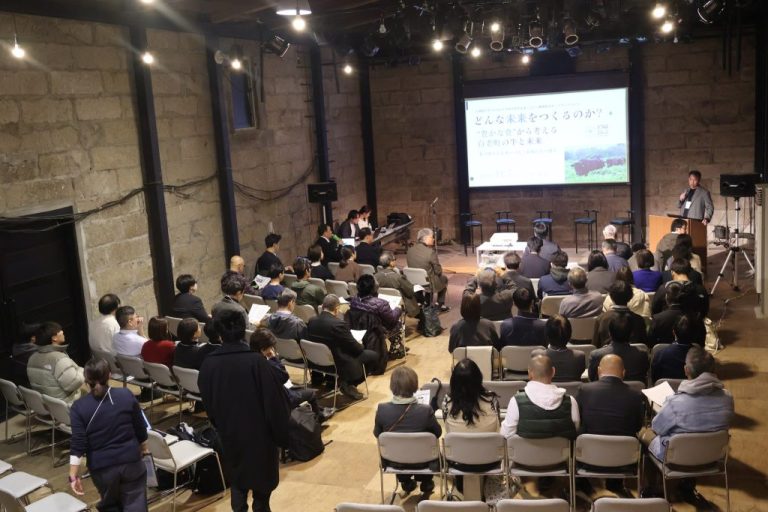
A New Challenge Begins in Shiraoi! – Next-Generation Wagyu Nexus Kickoff Event Held
Research Faculty of Agriculture
Sustainable Agricultural Production with Low Inputs and Reduced Environmental Impact
To achieve high-yield, high-quality agricultural and livestock production with lower inputs and reduced environmental impact, the Research Faculty of Agriculture is advancing integrated research ranging from fundamental studies of soil–microbe–plant–animal interactions to crop breeding, cultivation, livestock production, and smart farming.
By leveraging soil microbiome research, sensing technologies, genomics, machine learning, and crop modeling, the Research Faculty of Agriculture is developing agricultural production systems optimized for local environmental conditions. Research also focuses on crops adapted to low-fertilizer conditions, low-pesticide cultivation, crop monitoring using drones and satellite imagery, low-input livestock production, and technologies to enhance photosynthesis.
These efforts aim to establish sustainable agricultural and livestock production systems that combine resource and labor efficiency with reduced environmental impact.

Faculty of Fisheries Sciences
Sustainable Fisheries and Aquaculture in Harmony with Coastal Ecosystems
To achieve economically viable, low-emission, safe, and stable seafood production while maintaining healthy coastal ecosystems, the Faculty of Fisheries Sciences is advancing integrated research across aquaculture, ecosystem restoration, digital technologies, processing, and distribution.
Research includes the development of full-cycle aquaculture technology for Chinook salmon and fundamental studies toward sustainable full-cycle kelp aquaculture without reliance on wild resources. Other efforts include seaweed bed restoration through sea urchin population management and the development of digital twins for fisheries and aquaculture by integrating satellite, aerial, and field observations with monitoring data on fishing vessels, aquaculture environments, and fish populations.
In addition, research on life-cycle assessment (LCA), the utilization of underused resources, food safety, freshness preservation, and cold-chain systems aims to achieve both coastal ecosystem restoration and sustainable fisheries and aquaculture.

Field Science Center for Northern Biosphere (FSC)
Regenerative Green and Blue Field Science
Forests, croplands, grasslands, coastal areas, and seaweed beds are viewed as interconnected fields for advancing research on “Regenerative Green and Blue Field Science,” which supports the regeneration of natural capital and sustainable food production. This research also aims to quantify and visualize environmental value.
Green Field Science develops monitoring infrastructure across research forests and agricultural and livestock fields to continuously collect data on forest carbon storage, vegetation and soil conditions, grassland productivity, livestock behavior, and greenhouse gas emissions.
Blue Field Science develops observation and analytical infrastructure for coastal areas and seaweed beds to collect data on three-dimensional seaweed bed structures, blue carbon, material cycles, and biodiversity. These efforts provide scientific knowledge to support coastal ecosystem restoration and the sustainable use of fisheries resources.

Institute for Regenerative Agriculture, Forestry, Fisheries (IRAFF)
A new crossroads of knowledge across disciplines and organizational boundaries
The Institute for Regenerative Agriculture, Forestry, Fisheries (IRAFF) is a research hub that brings together knowledge and expertise across disciplines and organizational boundaries, including agriculture, fisheries science, environmental science, ecology, and life sciences.
IRAFF promotes the Future Creation Regenerative Research Support Program, which supports innovative research led by early-career researchers, as well as the Regional Extension Research Program, which supports large-scale interdisciplinary demonstration projects across Hokkaido. Through research funding, seminars and workshops, and human resource development, IRAFF aims to develop regenerative food systems that contribute to environmental restoration while ensuring sustainable food production.