
A paper by Professor Hiroshi Uji-i of Hokkaido University’s Research Institute for Electronic Science has been published in ACS Omega.
- Ya Tian, Qiang Zhang, Jiangtao Li, Motosuke Tsutsumi, Tomoko Inose, Farsai Taemaitree, Kenji Hirai, Kohsuke Kanekura, Hiroshi Uji-i. Raman Spectroscopy and FRAP Analysis on Density Heterogeneity and Diffusion Behavior of Complex Coacervation by Arginine-Rich Dipeptides and Poly-A RNA. ACS Omega, 2025, Vol. 10, Issue 35, pp. 40056–40065
DOI: https://doi.org/10.1021/acsomega.5c04844
Abstract
Membraneless organelles (MLOs), formed through liquid–liquid phase separation (LLPS), are vital for various cellular functions, including gene expression and RNA metabolism. Destructions of LLPS dynamics, often due to aberrant condensate formation, are implicated in neurodegenerative diseases. Polypeptides composed of repeated dipeptides, namely arginine-rich dipeptide repeat proteins, poly(proline-arginine) (poly-PR) and poly(glycine-arginine) (poly-GR), translated from mutated C9ORF72 repeats, undergo LLPS and disrupt RNA and protein homeostasis. Although these peptides have similar net charges, they exhibit different diffusion behaviors in liquid droplets, indicating that sequence-specific charge distribution may influence LLPS dynamics. In this study, we combined fluorescence recovery after photobleaching (FRAP) and Raman spectroscopy to examine the density heterogeneity and diffusion behavior of LLPS droplets formed by arginine-rich dipeptides and homopolymeric adenine RNA (poly-A RNA). We analyzed (PR)20, (P4R4)5, (same components but different charge pattern), and (GR)20 (same net charge as (PR)20, but different sequence). Our results showed that droplets formed with different dipeptides displayed heterogeneous diffusion behaviors, which strongly correlated to internal density gradients within individual droplets detected by Raman spectroscopy. This suggests that charge patterning, not just net charge, critically influences LLPS dynamics. FRAP results of small dye molecules with different net charges align with the concentration gradient of RNA and dipeptides obtained by Raman spectroscopy. Raman spectroscopy combined with FRAP provides a powerful approach for revealing the biophysical properties of biomolecular condensates.
Visual Abstract
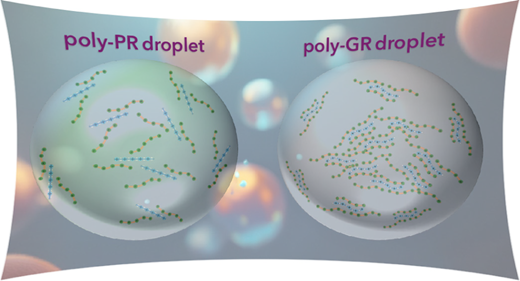
Credit: Tian et al., ACS Omega, 10(35), 40056–40065 (2025), https://doi.org/10.1021/acsomega.5c04844. © 2025 The Authors. Licensed under CC BY-NC-ND 4.0.