
A paper co-authored by Professor Toru Murayama of Hokkaido University’s Institute for Catalysis has been published in ACS Catalysis.
- Akira Oda, Terufusa Inagaki, Koyo Ichino, Yuya Kimura, Yuta Yamamoto, Wei Shi, Toru Murayama, Kyoichi Sawabe, Atsushi Satsuma. Durable CO-Assisted Ethane-to-Ethanol Oxidation in Water over Platinum–Titanium Nanoalloys Formed via Strong Metal–Support Interaction. ACS Catalysis, 2026, Vol. 16, Issue 5, pp. 5150–5158.
DOI: https://doi.org/10.1021/acscatal.5c09313
Abstract
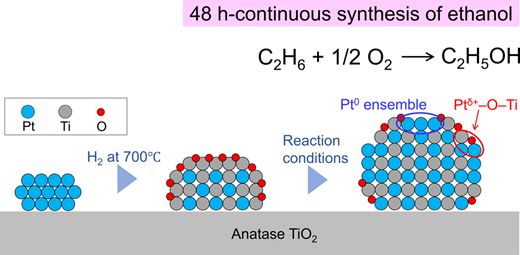
Selective ethane oxidation with O2 in the presence of CO offers a one-step route to ethanol, yet achieving high selectivity with long-term durability remains challenging because CO-assisted systems often undergo CO-induced sintering, which disrupts the cationic/metallic surface ensembles required for sustained activity. Here, platinum–titanium (Pt–Ti) nanoalloys formed on anatase TiO2 via strong metal–support interaction (SMSI) sustain aqueous ethane-to-ethanol oxidation at 125 °C for 48 h without measurable deactivation, maintaining 54–66% ethanol selectivity and delivering ∼670 mol of C2 oxygenates per molPt. Microscopy and spectroscopy indicate that Pt–Ti alloying stabilizes adjacent Ptδ+/Pt0 ensembles while suppressing CO-driven sintering. Mechanistic evidence supports a sequential pathway in which the CO-driven water–gas shift reaction generates H2, which in turn promotes in situ H2O2 formation from H2 and O2; the resulting H2O2 oxidizes ethane via an ethyl hydroperoxide intermediate to yield ethanol. These results establish SMSI-enabled Pt–Ti alloying as a viable materials strategy to couple selectivity with durability in CO-assisted aqueous ethane oxidation.
Visual Abstract
Subjects
Oxides; Oxidation; Platinum; Catalysts; Hydrocarbons
Keywords
Strong metal−support interaction; Pt−Ti nanoalloys; CO-induced sintering; Ethane-To-Ethanol oxidation; Ptδ+/Pt0 ensembles; Hydrogen peroxide
Credit: Oda et al., ACS Catalysis, 16(5), 5150–5158 (2026), https://doi.org/10.1021/acscatal.5c09313. © 2026 The Authors. Licensed under CC BY 4.0.