
A paper co-authored by Professor Shinji Nakaoka of Hokkaido University’s Faculty of Advanced Life Science has been published in EMBO Reports.
- Shunya Tsuji, Sosuke Nakano, Koyu Ito, Shohei Minami, Ken Uemura, Yusuke Konishi, Masahiro Wakita, Yumiko Okumura, Shimpei Kawamoto, Akari Matsuki, Shinji Nakaoka, Chikako Ono, Hiroo Takahashi, Itsuki Anzai, Tokiko Watanabe, Akiyoshi Uezumi, Yoshiharu Matsuura, Takeshi Kobayashi, Toru Okamoto, Akio Tsuboi, Masataka Asagiri, Eiji Hara. Senescence-like cells recruit γδ T cells to drive prolonged hyposmia after SARS-CoV-2 infection in mice. EMBO Reports, 2026, Vol. 27, Issue 10, pp. 2526–2548.
DOI: https://doi.org/10.1038/s44319-026-00769-6
Abstract
Persistent hyposmia is a hallmark of post COVID-19 conditions, yet the mechanisms sustaining olfactory dysfunction after viral clearance remain poorly understood. Here, using mouse models of SARS-CoV-2 infection, we show that virus-induced senescence-like changes in uninfected olfactory mucosal fibroblasts persist long after viral clearance and drive prolonged olfactory dysfunction. These senescence-like cells secrete SASP factors, including IFNγ, CXCL9, and CXCL11, thereby recruiting γδ T cells to the olfactory mucosa. The accumulated γδ T cells produce excessive IL-17A, which acts on IL-17 receptor A expressed on olfactory sensory neurons, leading to sustained impairment of their function. Genetic ablation of senescence pathways (p16/p21 double knockout), pharmacological elimination of senescent cells with the senolytic drug ABT263, or olfactory neuron-specific deletion of IL-17 receptor A each significantly alleviate prolonged olfactory dysfunction. These findings identify a senescence–γδ T cell–IL-17A axis as a key driver of prolonged hyposmia following SARS-CoV-2 infection in mice.
Synopsis
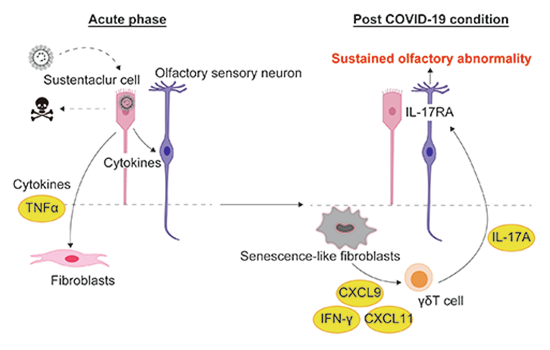
SARS-CoV-2 infection induces persistent senescence-like cells in the olfactory mucosa of mice that sustain olfactory dysfunction after viral clearance. These cells recruit γδ T cells via SASP factors, whose IL-17A production impairs olfactory sensory neuron function.
- SARS-CoV-2 induces senescence-like fibroblasts that persist after viral clearance in the olfactory mucosa of mice.
- Senescence-associated secretory factors recruit γδ T cells, promoting their accumulation in olfactory tissue.
- γδ T cell–derived IL-17A impairs olfactory sensory neuron function and sustains hyposmia.
- Genetic or pharmacological targeting of senescence or IL-17 signaling alleviates olfactory dysfunction.
Credit: Tsuji et al., EMBO Reports, 27(10), 2526–2548 (2026), https://doi.org/10.1038/s44319-026-00769-6. © The Author(s) 2026. Licensed under CC BY 4.0.