
A paper co-authored by Professor Toru Murayama of Hokkaido University’s Institute for Catalysis has been published in Nano Research.
- Bingxue Cheng, Xinlin Wang, Shijia Li, Yuhang Li, Toru Murayama, Tamao Ishida, Guangli Xiu, Kenji Iida, Yufan Fu, Yining Wang, Mingyue Lin. NbO₆ octahedra of high-dimensional Nb₂O₅ boosting H₂O₂ electrosynthesis for sewage pollutants degradation. Nano Research, 2025, Vol. 18, Issue 12, 94907917.
DOI: https://doi.org/10.26599/NR.2025.94907917
Abstract
Two-electron oxygen reduction reaction (2e− ORR) to produce hydrogen peroxide (H2O2) presents an efficient, secure, and sustainable method. However, the competing four-electron pathway produces H2O, yielding low H2O2 selectivity (~ 70%). In this work, a high-dimensional rod-like structure of niobium oxide (Nb2O5-HD) containing NbO6 octahedra was synthesized using a hydrothermal method combined with a calcination strategy. Under 50 mA·cm−2, the Faradaic efficiency (FE) of H2O2 reached 94%, with the H2O2 yield reaching as high as 874 mmol·gcat−1·h−1. After 34 h of operation, FE was still 76%, and the stability is great. In situ Raman spectroscopy analysis and experiments revealed that the NbO6 octahedra on Nb2O5-HD were the key factor for its excellent ORR activity and H2O2 FE. This inspires the development of high-performance ORR transition metal electrocatalysts.
Graphical Abstract
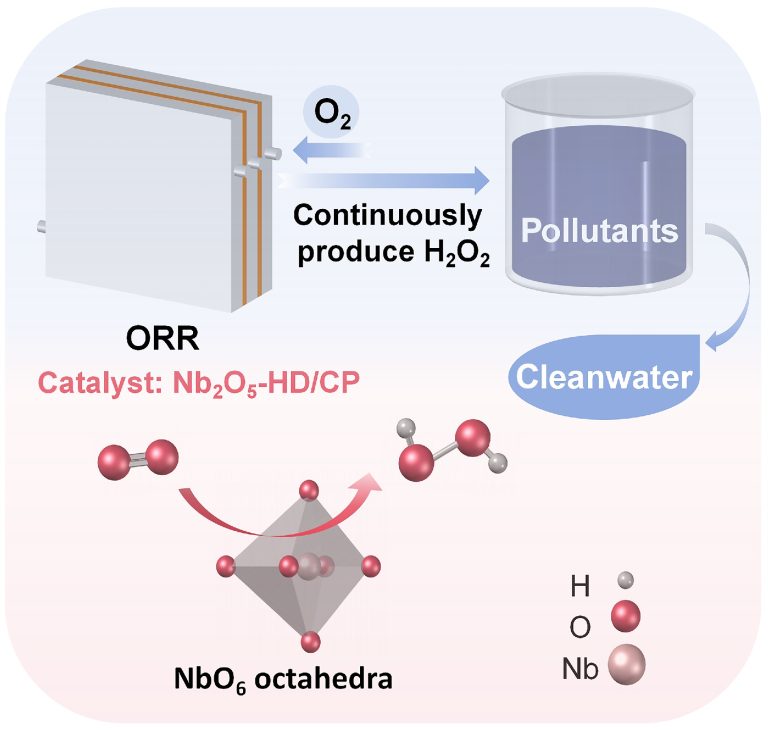
High-dimensional Nb2O5 enables efficient electrocatalytic oxygen reduction for H2O2 production via NbO6 octahedral units, achieving 94% Faraday efficiency and a high H2O2 yield of 874 mmol·gcat−1·h−1. The generated H2O2 effectively degrades methylene blue.
Keywords
oxygen reduction reaction; niobium oxide; hydrogen peroxide; pollutant degradation
Credit: Cheng et al., Nano Research, 18(12), 94907917 (2025), https://doi.org/10.26599/NR.2025.94907917. © The Author(s) 2025. Licensed under CC BY 4.0.