
Dr. Shiori Suzuki of Hokkaido University’s Research Faculty of Agriculture has published a paper in Green Chemistry.
- Amelia Klimek, Lina Amro, Nutthira Pakkang, Camélia Matei Ghimbeu, Elzbieta Frackowiak, Shiori Suzuki. Lignin as a precursor of a gel electrolyte and salt templated carbon for sustainable electrochemical capacitors. Green Chemistry, (2026) 28 (9): 4225–4242
DOI: https://doi.org/10.1039/d5gc05533d
Abstract
Electrochemical capacitors (ECs) belong to attractive high-power devices; however, their key components often do not meet ecological requirements. Herein, we propose a sustainable EC based on a gel electrolyte and porous carbon, both of which are made from lignosulfonate (LS), a waste-derived technical lignin from wood. First, the uptake ability of the LS-based gel electrolyte was systematically investigated using several concentrations (1–24 m) of aqueous acetate salt solutions containing different cations (Li, Na, and K). An optimized aqueous electrolyte, 5 m KOAc, was selected due to the high ionic conductivity and ion mobility. Next, LS was converted into porous carbons through an environmentally friendly salt templating approach using NaOAc and KOAc, which enabled precise control of the carbon structure and texture. The resulting carbons exhibited predominantly microporous characteristics with specific surface areas ranging from 881 to 1754 m2 g−1. Raman spectroscopy analysis revealed various degrees of structural disorder (ID1/IG ranged from 1.37 to 3.00). Finally, ECs were assembled with the LS-based gel electrolyte and salt templated carbons. They achieved a stable operating voltage (1.6 V), reduced self-discharge (loss of ∼30% of initial voltage), and a long lifespan (170 h of floating), which is competitive with reference aqueous ECs (loss of ∼40% of initial voltage and 120 h of floating). Importantly, the LS gel plays a two-in-one role as an electrolyte and a separator. The lack of electrolyte leakage also ensures safety of the device. To sum up, our study proved that water-soluble LS waste can be transformed into components of green energy storage systems.
Visual Abstract
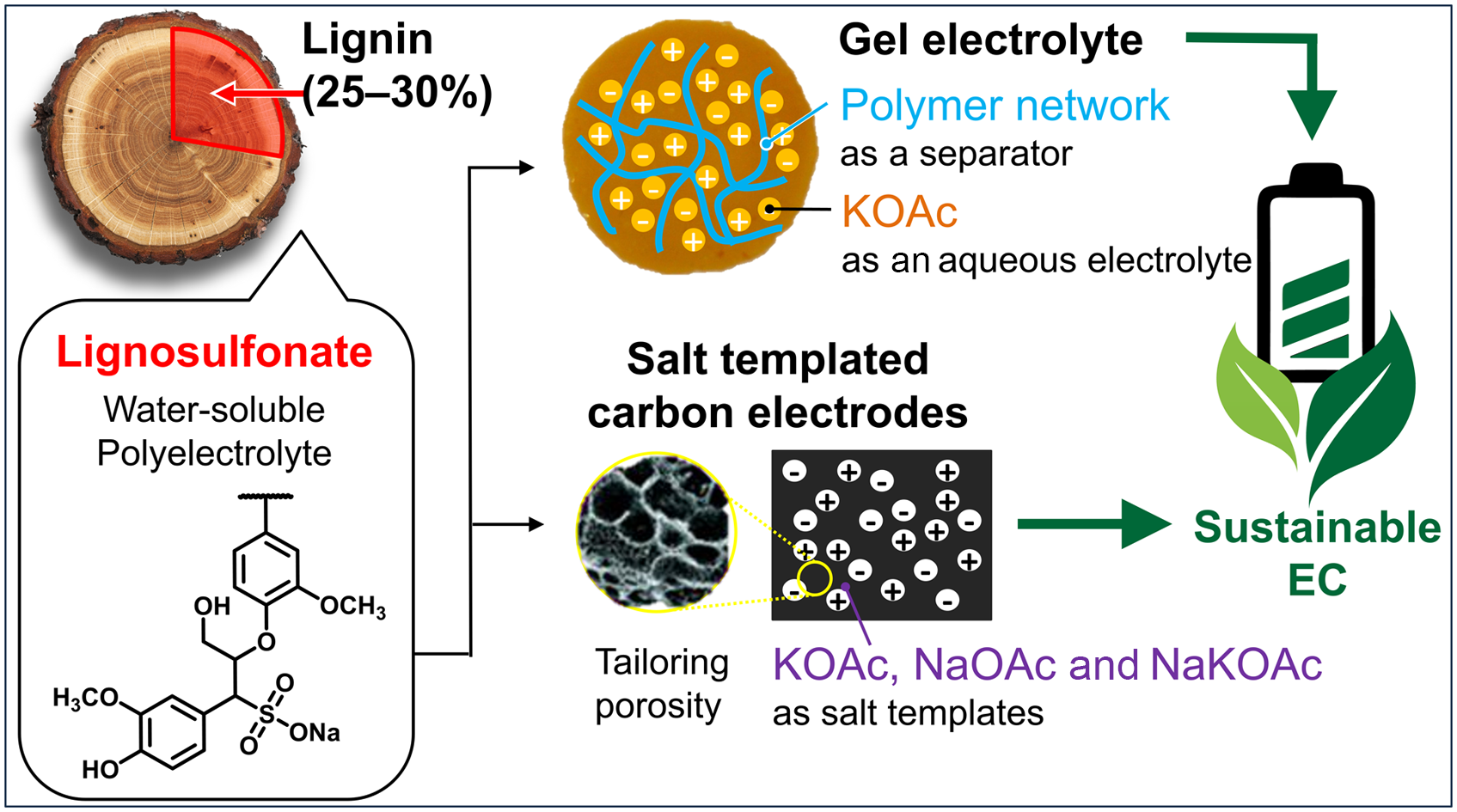
Source: Klimek et al., Green Chemistry (2026), https://doi.org/10.1039/D5GC05533D. Licensed under CC BY 4.0.